NXP 74HC2G34GW: A Comprehensive Technical Overview of the Dual Non-Inverting Buffer Gate
The NXP 74HC2G34GW represents a fundamental yet critical component in the vast ecosystem of digital logic. As part of the 74HC family, this integrated circuit is a dual non-inverting buffer gate, packaged in a space-saving and modern form factor. It serves as an essential building block for signal conditioning, amplification, and isolation within countless electronic designs, from consumer gadgets to sophisticated industrial systems.
Core Functionality and Logic
At its heart, the 74HC2G34GW contains two independent buffer gates. A buffer's primary function is to reproduce the input signal at the output without logical inversion. When the input is high (logic '1'), the output is also high. Similarly, a low input (logic '0') results in a low output. This simple operation is deceptively powerful. It is primarily used for signal amplification and improving noise immunity, enabling a weak input signal to drive heavier loads, such as long traces or multiple downstream inputs, without degradation.
Key Electrical Characteristics
The "HC" in its designation signifies High-speed CMOS technology. This affords the device several advantages:
Low Power Consumption: Inherited from CMOS design, it features very low static power dissipation, making it ideal for battery-operated and power-sensitive applications.
High Speed: It offers propagation delays typically as low as 8 ns (at 5V, CL=15pF), allowing it to perform effectively in moderately high-speed digital circuits.
Wide Operating Voltage: The device supports a voltage range from 2.0 V to 6.0 V, providing significant flexibility for interfacing with various logic families and microcontrollers operating at 3.3V or 5V.
High Output Current: It can sink or source up to 4 mA, providing robust drive capability for LEDs, relays, or other logic gates.
Package and Applications
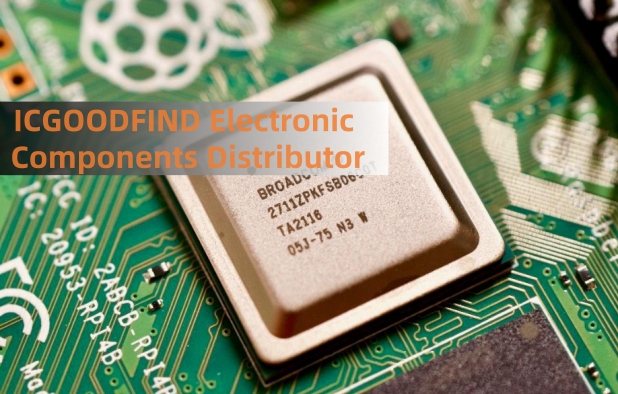
The "GW" suffix denotes the package type: a leadless SOT353 (SC-88A) surface-mount package. This extremely small footprint is crucial for modern, miniaturized PCB designs found in portable electronics. Typical applications extend far beyond simple signal passing:
Bus Buffering: Isolating sections of a data bus to prevent loading and maintain signal integrity.
Clock Signal Conditioning: Cleaning up and distributing clock signals from a microcontroller.
Logic Level Shifting: Interfacing between devices operating at different voltage levels (e.g., 3.3V to 5V).
Increasing Fan-out: Allowing a single output to drive a larger number of inputs than it could handle directly.
Tactile Switch Debouncing: Providing a clean digital signal from a mechanical switch input.
Robustness and ESD Protection
NXP enhances this logic gate with robust features for real-world reliability. The inputs and outputs are protected against electrostatic discharge (ESD). This is critical for handling and operation in environments where static electricity is a concern, significantly improving the overall durability of the end product.
The NXP 74HC2G34GW is far more than a simple logic gate; it is a testament to the enduring importance of fundamental components in evolving electronic design. Its combination of high-speed CMOS performance, low power consumption, and an ultra-miniaturized package makes it an indispensable solution for designers seeking to improve signal integrity, manage power budgets, and save valuable board space in a vast array of modern applications.
Keywords:
Dual Non-Inverting Buffer, CMOS Technology, Signal Integrity, SOT353 Package, Logic Level Shifting.

